
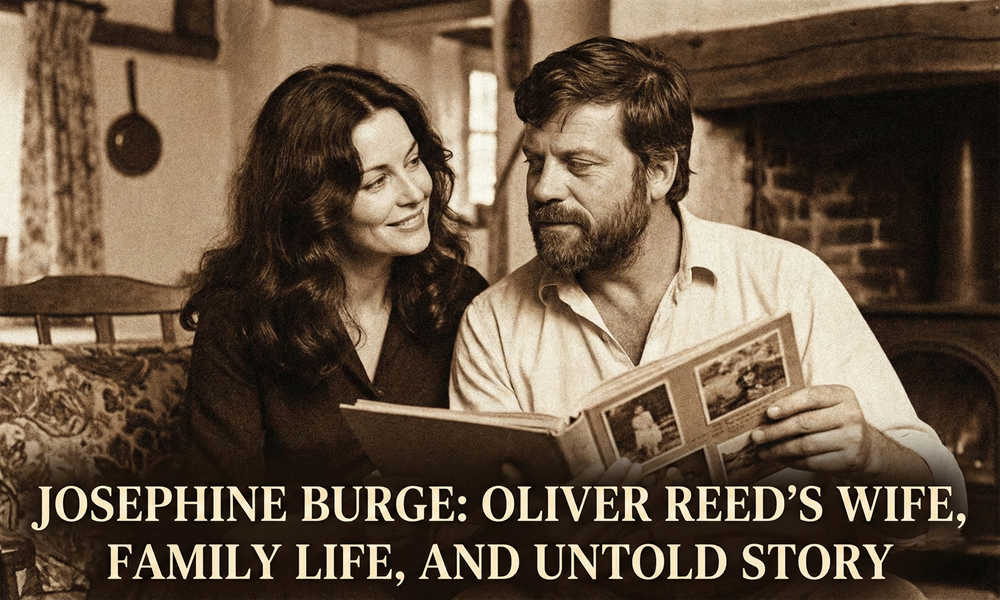
In the glittering yet chaotic world of British cinema, certain names become synonymous with fame and fortune. Yet behind many celebrated figures stand individuals who choose a different path—one of privacy, dignity, and unwavering support. Josephine Burge represents precisely this rare breed of character. Known primarily as the devoted wife of legendary actor Oliver Reed, her story transcends the typical narrative of a celebrity spouse. It is a testament to resilience, loyalty, and the profound impact of choosing family over fame.
Early Life and Background
Born in 1964 in the United Kingdom, Josephine Burge entered the world far removed from the glare of Hollywood spotlights. Details about her early years remain deliberately scarce, reflecting a lifetime commitment to privacy that would define her character. Unlike her future husband, whose every move was chronicled by tabloids, Josephine cultivated values of discretion, composure, and quiet strength from a young age.
Her upbringing instilled in her an appreciation for normalcy—a quality that would prove invaluable when navigating the turbulent waters of life with one of Britain’s most notorious actors. While the world knew Oliver Reed for his commanding screen presence and equally commanding personal excesses, few understood the woman who would eventually become his anchor.
The Meeting That Changed Everything
The year was 1980 when 16-year-old Josephine Burge first encountered Oliver Reed, then 42 years old and at the height of his fame. Their initial meeting sparked immediate controversy due to the significant age gap, with critics quick to question the nature of their relationship. However, those close to the couple witnessed something far more substantial than tabloid speculation—a genuine connection built on mutual respect and affection.
Reed, whose first marriage had ended in divorce in 1969, was known for his volatile personality and legendary drinking habits. He had already established himself as one of British cinema’s most formidable talents, with iconic roles in films like “Oliver!” (1968), “Women in Love” (1969), and “The Devils” (1971). Yet despite his professional success, Reed’s personal life remained tumultuous until Josephine entered the picture.
Key Timeline of Their Relationship
| Year | Milestone |
|---|---|
| 1980 | Josephine and Oliver first meet |
| 1985 | Marriage ceremony in Epsom, Surrey (September 7) |
| 1990s | Relocation to Churchtown, County Cork, Ireland |
| 1999 | Oliver Reed passes away during filming of Gladiator |
A Marriage of Contrasts

On September 7, 1985, Josephine Burge and Oliver Reed were married in a civil ceremony in Epsom, Surrey. Wedding photographs from that day capture a moment of rare tenderness—Reed’s typically rugged features softened beside his bride, who radiated an effortless grace and calm elegance. At 21, Josephine was embarking on a journey that would test her resolve, compassion, and strength in ways few could imagine.
Their marriage represented a study in contrasts. Reed’s public persona was loud, unpredictable, and often destructive. His reputation for excessive drinking was well-documented, with legendary tales of marathon pub crawls with fellow actors like Richard Burton, Richard Harris, and Keith Moon. One famous anecdote claimed Reed consumed 106 pints of beer during a two-day binge before his wedding to Josephine, though he later clarified the story had been exaggerated.
Josephine, conversely, embodied restraint and stability. She attended public events when necessary but consistently prioritized family life. While Reed continued his high-profile career, appearing in films like “Gladiator” (released posthumously in 2000), Josephine worked behind the scenes to create a sanctuary away from the chaos—a home where their family could thrive despite the surrounding storm.
Building a Family in the Spotlight’s Shadow
Josephine and Oliver Reed had two children together during their marriage. The exact details of their children remain deliberately protected, reflecting Josephine’s fierce commitment to shielding her family from media intrusion. Most sources reference a daughter named Sarah Reed, while some mention a son as well, though specifics about their lives remain closely guarded.
Josephine’s Approach to Motherhood:
- Privacy Protection: She limited all media exposure, ensuring her children experienced as normal an upbringing as possible
- Emotional Stability: Created a calm, secure home environment vital for children growing up with a celebrity parent
- Strong Family Bonds: Fostered close relationships emphasizing love, respect, and support over public recognition
- Educational Focus: Ensured proper education and personal development away from Hollywood pressures
The decision to relocate to Churchtown, County Cork, Ireland, in the early 1990s exemplified Josephine’s priorities. This move allowed the family to escape the relentless media attention that plagued them in England. In Ireland’s countryside, surrounded by open land and rural communities, they found the peace that had eluded them elsewhere. Reed, who had always been drawn to pub culture and slower-paced living, thrived in this environment, and Josephine skillfully managed their household while maintaining the family’s privacy.
The Woman Behind the Legend
What made Josephine Burge truly remarkable was not just her ability to endure Reed’s excesses but her capacity to provide genuine stability without seeking recognition. In an era when many celebrity spouses leveraged their connections for personal gain, Josephine chose the opposite path.
She never pursued a career in entertainment, never granted tell-all interviews, and never capitalized on her association with one of Britain’s most celebrated actors. Her strength lay in her restraint—a quality that proved more powerful than any publicity campaign could ever achieve.
Friends and colleagues of Oliver Reed frequently remarked on Josephine’s transformative influence. While they couldn’t tame Reed’s wild nature entirely, she offered him something precious: unconditional acceptance and a safe haven from the demands of fame. This quiet support allowed Reed to continue his craft while knowing he had a stable foundation to return to.
Life After Loss
On May 2, 1999, Oliver Reed suffered a fatal heart attack while filming “Gladiator” in Malta. He was 61 years old, and his passing shocked the entertainment world. For Josephine, then 35, it marked the end of a 14-year marriage and the beginning of a new chapter defined by grief, resilience, and continued dedication to privacy.
In the aftermath of Reed’s death, Josephine retreated further from public view. She did not participate in media retrospectives about her husband’s life, nor did she contribute to the numerous documentaries and biographies that followed. This silence was not born of bitterness but of a desire to preserve her family’s dignity and protect her children from further scrutiny.
According to some reports, Josephine remarried in 2001 to Walter Ryan-Purcell, a country squire from County Cork. She described this union as one between soulmates, emphasizing emotional connection over public spectacle. However, true to form, details about her second marriage remain private, with Josephine continuing to shield her personal life from media attention.
Current Life and Legacy
As of 2025, Josephine Burge is 61 years old and reportedly continues to live in Ireland, though specific details remain unconfirmed due to her steadfast commitment to privacy. She has not granted interviews, made public appearances, or engaged with social media, maintaining the same principled approach to privacy that has characterized her entire adult life.
Why Josephine Burge Matters
Josephine’s story resonates because it represents an increasingly rare phenomenon in our age of constant connectivity and self-promotion:
- Authentic Privacy: In a world obsessed with sharing every detail online, Josephine demonstrates that it’s possible to live meaningfully without public validation
- Strength Through Support: Her life illustrates that supporting others’ success requires its own form of courage and sacrifice
- Family-First Values: By prioritizing her children’s wellbeing over potential fame or fortune, she exemplified parental dedication
- Dignity in Grief: Her handling of widowhood—without exploitation or attention-seeking—shows profound emotional maturity
- Counter-Cultural Example: She stands as proof that not everyone connected to fame seeks the spotlight themselves
The Absence of a Wikipedia Page
Unlike many figures associated with major celebrities, Josephine Burge does not have a dedicated Wikipedia page. This absence speaks volumes about her successful efforts to remain private. Most information about her appears within the context of Oliver Reed’s biographies, where she is typically described as his second and final wife—the person who brought him peace in his later years.
This lack of detailed public documentation is not an oversight but a direct result of Josephine’s choices. She has never sought recognition, never courted publicity, and never attempted to build a personal brand separate from her role as wife and mother.
Lessons from a Private Life
In our contemporary culture, where personal branding and social media presence have become almost obligatory, Josephine Burge’s life offers valuable insights:
The Power of Boundaries: By establishing and maintaining firm boundaries between public curiosity and private reality, Josephine protected what mattered most—her family’s wellbeing and peace of mind.
Love Without Conditions: Her relationship with Oliver Reed demonstrates that true partnership means accepting someone fully, flaws included, while still maintaining one’s own integrity and values.
Success Redefined: While the world measures success in fame, wealth, and recognition, Josephine’s story suggests an alternative metric—the quality of relationships, the stability of family life, and the peace that comes from living according to one’s values.
Conclusion
Josephine Burge remains a figure of quiet dignity in the often-loud world of celebrity culture. While her husband Oliver Reed commanded attention through larger-than-life performances and equally outsized personal behavior, Josephine chose a different kind of strength—one rooted in privacy, loyalty, and unwavering family commitment.
Her legacy is not measured in box office receipts or award nominations but in the stable home she created, the children she protected, and the support she provided to one of British cinema’s most complicated figures. In an age where everyone seems desperate for their fifteen minutes of fame, Josephine Burge stands as a powerful reminder that some of life’s most meaningful contributions happen far from the spotlight.
Today, at 61, she continues to live life on her own terms—private, purposeful, and profoundly principled. For those seeking to understand the complete story of Oliver Reed, understanding Josephine Burge is essential. She was not merely the woman beside the legend; she was the foundation that made much of that legend possible. And in choosing privacy over publicity, dignity over drama, she created her own legacy—one that speaks to the enduring power of quiet strength in a noisy world.