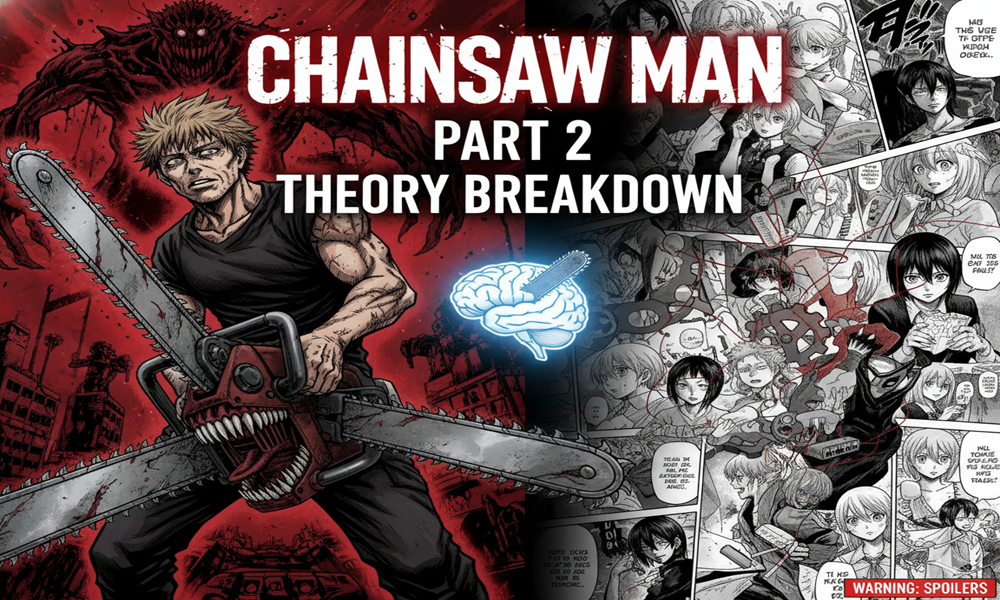
Introduction: The End That No One Saw Coming
I’ve been following Chainsaw Man since the earliest chapters of Part 1, and I’ll be honest with you — nothing prepared me for what happened on March 10, 2026. Chapter 231, titled “Goodbye, Pochita,” dropped with the gut-punch announcement that Chainsaw Man Part 2 ends with Chapter 232 on March 24/25, 2026.
No buildup. No months-long farewell arc. Just a single line at the bottom of a page — and the internet promptly lost its mind.
Whether you’re a manga-only reader, an anime fan who watched MAPPA’s legendary Season 1, or someone who just watched Chainsaw Man – The Movie: Reze Arc in theaters, this guide is going to walk you through every major theory circulating right now, break down what actually happened in Chapter 231, and answer the question everyone is asking:
Is this really the end of Chainsaw Man — or is Part 3 coming?
Let’s get into it.
What Actually Happened in Chainsaw Man Part 2?
Before we dive into theories, let me give you a quick orientation of Part 2 as a whole — because it’s a very different beast from Part 1.
The Shift From Part 1 to Part 2
Part 1 (Chapters 1–97, the Public Safety Arc) was a brutally focused story: Denji, a desperate teenager fused with the Chainsaw Devil Pochita, becomes a devil hunter under the control of the mysterious Makima. It ended with Denji defeating Makima by eating her — and inheriting Nayuta, the new reincarnation of the Control Devil, as his ward.
Part 2 — officially called the Academy Saga — launched on July 13, 2022, and introduced an entirely new protagonist: Asa Mitaka, a high school student who becomes the host of Yoru, the War Devil. The world has changed too: Chainsaw Man has become a pop-culture icon, with branded merchandise and even food items bearing his likeness. Society has adapted to devils being a known part of everyday life.
That societal shift wasn’t just worldbuilding flavor. It was Fujimoto making a statement about fandom itself — more on that later.
The Four Horsemen and Primal Fears
Part 2 introduced the Four Horsemen: Famine, War (Yoru), Death, and Conquest. These are the most powerful devil concepts in existence, and their conflict formed the thematic backbone of the saga. We were also introduced to the Primal Fears — ancient devils so terrifying they cannot be erased even by the Chainsaw Devil, because humanity’s fear of them is too deep-rooted.
The central war between Yoru and Chainsaw Man, the mystery of what Yoru’s endgame truly was, and the cosmic implications of Death as a devil — these were the threads Part 2 spent over 130 chapters weaving.
And then, in Chapter 231, Fujimoto pulled the rug out from under all of it.
Chapter 231 Breakdown: “Goodbye, Pochita”
This is the chapter that broke fandom. Here’s what happened, step by step.
Denji Is Eaten — Off-Screen
Chapter 230 ended with Denji, low on blood, unable to transform into Chainsaw Man, surrounded by a horde of insect devils. Chapter 231 skips past the fight entirely. Denji has already been eaten. He wakes up in a dream-like space — Hell, where all devils go after being consumed.
It’s a jarring narrative choice, and deliberately so. Fujimoto denies us the heroic last stand. There is no dramatic transformation sequence. The Chainsaw Man just… loses, quietly, off-page.
Pochita’s Final Monologue
Inside this liminal space, Denji and Pochita have one last conversation. It mirrors the opening of the entire series almost note for note — two lonely beings talking in the dark.
Pochita tells Denji their dream life is over, “but maybe that’s a good thing.” He reflects on everything Denji achieved in Part 2: going to school, forming a connection with Asa, experiencing something close to a normal life. But Pochita noticed something Denji himself couldn’t fully admit — Denji was still unhappy. Every milestone was hollow. Every connection left a void.
Pochita’s diagnosis is sharp and painful: Denji has what he calls “the crappiest, but best kind of brain. One that can only find heaven when you’re in hell.” Denji was happiest when he was starving, fighting for survival, eating stale bread in a run-down shack. Comfort and normalcy didn’t give him meaning — they gave him emptiness.
So Pochita makes a decision.
Pochita Eats Himself
In one of the most emotionally devastating pages in the entire manga, Pochita rips out his own heart. He tells Denji he is going to eat himself — erasing the Chainsaw Devil from existence entirely.
In Chainsaw Man’s lore, whatever the Chainsaw Devil consumes is erased from reality. People forget it ever existed. By consuming himself, Pochita would create a world where Chainsaw Man never existed.
His final words to Denji: “Keep on dreaming.”
Then everything goes black.
The final page of Chapter 231 shows a single image: Denji’s old shack, in the rain. The same ramshackle hut from Chapter 1. The implication is unmistakable — we are back at the very beginning.
The Big Theories: What Does It All Mean?
The moment Chapter 231 dropped, fan communities exploded. Here are the four major theories dominating the conversation right now, along with my own take on each.
Theory 1: The Timeline Has Been Reset — This Is a True Ending
The argument: Pochita erased himself. The timeline resets to before Denji ever met Pochita. Denji never becomes Chainsaw Man, never joins Public Safety, never fights Makima, never meets Asa. He lives out his ordinary life — probably a short one, since without Pochita he has no means of survival. Chapter 232 is a quiet, bittersweet epilogue showing a world without Chainsaw Man, and that’s the end.
Why it works: Fujimoto himself, in an interview with Da Vinci magazine, said he wanted Chainsaw Man to have the unresolved, “what even was that?” energy of The Big Lebowski — a film where nothing is really resolved, but the protagonist still grows, and there’s a sublime absurdity to it all. A true reset ending fits that philosophy perfectly. The story becomes a tragedy about a boy who was happiest when suffering, freed at last from the cycle — but at the cost of everything he built.
The emotional logic is also there. The entire thesis of Chainsaw Man is that Denji chases happiness but is constitutionally unable to recognize it when he has it. Removing Chainsaw Man from existence doesn’t “fix” Denji — it just removes the supernatural machinery that kept trapping him in bigger and bigger loops of violence and trauma.
Why it doesn’t fully satisfy: Part 2 introduced too many unresolved threads for this to feel complete. Nayuta’s fate, the Blood Devil (Power’s reincarnation), the full Four Horsemen conflict, the Nostradamus prophecy — these don’t get resolved. A true ending here would leave the reader feeling like half the story was never told.
Theory 2: This Is the End of Part 2 — Part 3 Is Coming
The argument: This is the most popular theory, and frankly, the one I find most convincing. The structure mirrors Part 1 almost exactly. Chapter 96 ended with Denji about to eat Makima, followed by an announcement that Chapter 97 was the “final chapter.” That chapter resolved Part 1’s Public Safety Arc — but it was Part 1, not the end of the series. Part 2 launched months later.
Right now, Manga Plus — one of the official platforms for the manga — initially showed the “final chapter” notice on Chapter 231, then quietly updated it to simply read “to be continued.” That’s not nothing. That’s a platform hedging its bets on what this ending actually means.
The structural argument is compelling: Part 1 could have genuinely ended with Chapter 97. Every major arc was resolved. Part 2 cannot end with Chapter 232 in any satisfying way. There is simply too much left undone. This isn’t a deliberate “open ending” — it’s an abrupt cut in the middle of a war.
The most natural read is that Pochita’s reset sets up a radically altered world for Part 3 to explore. A world where Chainsaw Man never existed would be a horror setting of a different kind — devils running rampant, the Primal Fears unchecked, and Denji navigating it all as just a human.
What Part 3 could look like: If the reset holds, Part 3 might center on Asa Mitaka as the primary protagonist — she’s arguably been the true main character of Part 2 anyway. Denji would exist in this new world, but without Chainsaw Man’s power, without his memories of the old timeline (unless Fujimoto pulls a clever narrative trick). The Four Horsemen would presumably still exist. The Primal Fears would still exist. And someone would have to face them without the one devil powerful enough to erase anything.
Theory 3: The Reset Fails — Denji Faces the Apocalypse Alone
The argument: Pochita’s self-erasure doesn’t work as planned. Either the other Primal Fears prevent it, or the mechanics of the devil-eating ability don’t apply to Pochita consuming himself. The timeline doesn’t reset — instead, Denji simply wakes up in a world where Chainsaw Man is gone and he’s powerless.
In this version, Chapter 232 ends not on hope but on horror. The world is collapsing — death has been eliminated, the insect swarms are multiplying, and Denji is just a kid with no powers and no devil by his side. That’s the ending. That’s the nightmare.
This is the darkest reading, and it’s entirely consistent with Fujimoto’s sensibility. Fire Punch — his earlier series — ended on an equally bleak note of cosmic futility. Fujimoto has never been obligated to give us a happy ending.
Why fans are split on this: If this is the ending, it retroactively makes Part 2 feel like a story about a protagonist who never had a chance. Asa’s arc, the War Devil conflict, Nayuta’s sacrifice — all of it led to Denji losing anyway. Some readers would find that thematically resonant. Others would find it a betrayal of the investment the series asked of them.
Theory 4: Denji Retains His Memories — Meta-Commentary on Narrative Reboots
The argument: This is the most intellectually ambitious theory, and it connects directly to Part 2’s biggest running theme: Chainsaw Man as a pop-culture object commenting on its own existence.
Part 2 was saturated with meta-commentary. The fact that Denji has merchandise and fan clubs. The fact that his heroic identity has been commodified and flattened by the culture machine. Fujimoto was clearly writing a story about what it means to be a shonen protagonist in the age of fandom — where the character becomes a product, and the story becomes something fans own and fight over.
If the reset happens and Denji retains his memories of the erased timeline, Part 3 becomes a story about a character who knows he’s living a rerun. He remembers everything that happened. He knows who Asa is before he meets her. He knows how Makima dies. He exists in a world that has been “rebooted,” and he has to decide whether to fight the cycle again or find a way to truly break it.
This reading is supported by one of Fujimoto’s known influences: the concept of the “sisyphean loop” — Denji endlessly pushing the boulder up the hill of happiness, never quite reaching the top. Part 3 with memory-intact Denji would be a story about breaking free from the loop, not just resetting it.
My honest take: This is the theory I want to be true. It’s the most thematically rich and the one that would most justify everything Part 2 built. But I’m cautious — Fujimoto has made a career of subverting what fans want.
Unresolved Threads That Demand a Part 3
Even if you’re skeptical about Part 3, let me lay out everything that Chapter 232 would need to address — in a single chapter — for Part 2 to stand as a complete story:
- Power’s reincarnation (the Blood Devil): The contract between Denji and Power — that she would find him in her next life — has never been fulfilled. This was set up as one of the most emotionally significant promises in the entire series.
- Nayuta’s fate: Is she dead? If so, who is the new Control Devil? If she’s alive, where is she?
- The Four Horsemen: Death, Famine, and Conquest have barely been explored as characters. Their full significance has never been realized.
- The Nostradamus Prophecy: Introduced over 100 chapters ago and still dangling.
- The Primal Fears: We’ve seen fragments, but their full role in the cosmology of the series remains unexplained.
- Asa Mitaka’s arc: Her journey as a host for the War Devil is deeply unresolved. What does Yoru actually want? What is Asa’s ultimate choice?
None of these get answered in a single chapter. Which, again, strongly points toward this being an end of a part, not an end of the story.
What the Anime Confirms About the Future
Here’s a piece of evidence that often gets lost in the manga discourse: the Chainsaw Man anime is not finished.
Season 1 (2022) adapted the early Public Safety Arc. Chainsaw Man – The Movie: Reze Arc released in Japanese theaters in September 2025. And according to current reports, a Chainsaw Man anime covering the Assassins Arc has been confirmed for future release.
Why would MAPPA invest in adapting more of Part 1 if the entire franchise was ending with Chapter 232? The anime timeline doesn’t add up to a series wrapping up. If anything, it suggests the franchise has a long runway ahead — which supports the idea that Fujimoto is pausing the manga between parts, not killing the series.
Fujimoto’s Storytelling Philosophy: Why This Ending Makes Sense
To understand what Chainsaw Man is doing right now, you have to understand how Tatsuki Fujimoto thinks about endings.
His debut series Fire Punch ended with a profoundly strange, ambiguous conclusion that left readers divided. Look Back, his acclaimed one-shot, dealt with grief and creation in a way that felt simultaneously hopeful and unbearably sad. In every case, Fujimoto resists easy resolution.
His stated goal with Chainsaw Man was that same Big Lebowski energy — a story where “nothing is resolved, but the protagonist has development.” That framing is crucial. Denji doesn’t need to defeat the ultimate evil or get the girl or transcend his circumstances. He needs to grow, even if the world around him remains chaotic and violent and absurd.
Pochita’s sacrifice is Denji’s growth, filtered through his most loyal companion. Pochita understood something about Denji that Denji could never admit: that he needed to find a version of himself that existed without Chainsaw Man. Not because Chainsaw Man was a curse, but because as long as Denji was Chainsaw Man, he would always be defined by violence, by appetite, by the endless cycle of wanting and getting and feeling empty.
The shack on the final page isn’t just a callback. It’s a thesis statement.
My Take: What I Think Chapter 232 Will Do
I’ve been sitting with this for a few days now, and here’s where I land:
I think Chapter 232 will be a transitional ending, not a final one. It will show us a reset world — Denji’s shack, a younger version of him, a life without Pochita. And it will end not with a resolution but with a question mark. The same structural move Part 1 made, leaving the door open for what comes next.
The difference between this and Part 1’s ending is emotional weight. Part 1 ended with Denji triumphant, moving forward. Part 2 ends with Denji erased — not dead, but unmade. What Part 3 does with that is going to define Fujimoto’s legacy.
And whether it comes in six months or two years, I believe Part 3 is coming.
Frequently Asked Questions
Q: Is Chainsaw Man Part 2 definitely over?
Yes. Chapter 231 confirmed that Part 2 ends with Chapter 232, releasing March 24/25, 2026.
Q: Is the entire Chainsaw Man series ending?
That is unconfirmed. Fujimoto has not made a public statement. Many fans and analysts believe Part 3 will be announced, but nothing is official yet.
Q: Where can I read Chapter 232?
Officially on Viz Media and Manga Plus. Both platforms offer the latest chapters, with Manga Plus being free globally and Viz Media requiring a subscription for archive access.
Q: What happened to Pochita?
In Chapter 231, Pochita rips out his own heart and eats it — erasing himself from existence. This is consistent with the Chainsaw Devil’s power to erase whatever he consumes.
Q: Is the Chainsaw Man anime still happening?
Yes. The Reze Arc movie has already released, and a future anime arc (the Assassins Arc) has been confirmed. The anime timeline strongly suggests the franchise isn’t ending.
Conclusion: The Dream Continues
Chainsaw Man Part 2 ends the way it began — with a boy in a shack, alone, in the rain.
That image shouldn’t feel like defeat. It should feel like a question. What does Denji become when he’s no longer Chainsaw Man? What does the world look like when the devil that could erase anything erases itself? And what does Tatsuki Fujimoto do with a story that has always been about the gap between wanting and having, between dreaming and living?
I don’t have all the answers. Honestly, I don’t think anyone does until Chapter 232 drops on March 24th. But if there’s one thing Fujimoto has always delivered, it’s this: the ending you didn’t expect, that somehow makes everything before it feel inevitable.
That’s what makes Chainsaw Man special. And that’s why, no matter how Part 2 closes, this story isn’t done with us yet.