
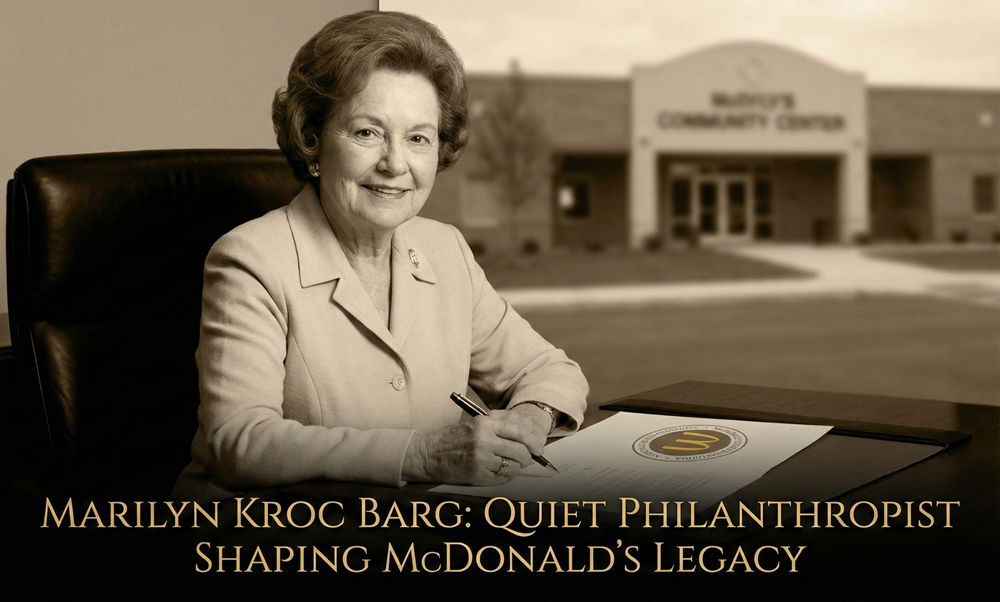
When you hear “Kroc,” your mind probably jumps straight to McDonald’s golden arches and fast food history. But there’s another story worth knowing—one about compassion, quiet generosity, and a woman who chose kindness over the spotlight. Meet Marilyn Kroc Barg, daughter of McDonald’s visionary Ray Kroc, whose legacy extends far beyond her famous last name.
Who Was Marilyn Kroc Barg?
Marilyn Janet Kroc Barg was born on October 15, 1924, in Chicago, Illinois, as the only child of Ray Kroc and Ethel Janet Fleming. While her father transformed a small burger joint into a global phenomenon, Marilyn carved out her own path—one defined by philanthropy, empathy, and genuine care for families in need.
She lived just 48 years, passing away on September 11, 1973, but her impact continues to touch thousands of lives every single day through the charitable work she helped establish.
Quick Facts About Marilyn Kroc Barg
| Detail | Information |
|---|---|
| Full Name | Marilyn Janet Kroc Barg |
| Nickname | Lynn (used by family) |
| Birth Date | October 15, 1924 |
| Birthplace | Chicago, Illinois |
| Death Date | September 11, 1973 |
| Age at Death | 48 years |
| Parents | Ray Kroc & Ethel Janet Fleming |
| First Marriage | Sylvester Nordly Nelson (1949 – divorced) |
| Second Marriage | Walter James Barg (1960 – 1973) |
| Known For | Philanthropic work, Ronald McDonald House Charities |
Growing Up as Ray Kroc’s Daughter
Imagine growing up in 1920s Chicago—jazz filling the air, the city buzzing with energy, and your dad working as a traveling salesman. That was Marilyn’s childhood. Ray Kroc worked as a paper cup salesman and later sold Multimixers, machines that could mix multiple milkshakes at once.
The Kroc family lived through challenging times, and these early experiences helped Marilyn develop resilience and a caring nature. Her mother, Ethel Janet Fleming, was a former silent film actress who gave up her career to focus on family. From her mother, Marilyn learned grace and humility. From her father, she witnessed relentless determination—though she’d use that drive very differently than he did.
As an only child, Marilyn received her parents’ full attention, but she also saw the toll Ray’s ambitions took on family life. His long work hours and constant travel meant Marilyn spent more time with her mother, developing the compassionate nature that would define her later years.
A Father’s Success, A Daughter’s Independence
When Ray Kroc obtained and began running McDonald’s from 1961, he turned it into the most successful food corporation in the world. By the time Ray passed away in 1984, McDonald’s had 7,500 locations in the US alone, and he left behind an estimated fortune of $600 million.
But here’s what’s fascinating: Marilyn didn’t chase that business success. She wasn’t interested in board meetings or franchise expansion. Instead, she asked herself a different question—how could she use her resources to help people who were hurting?
This is where her story gets really beautiful.
Two Marriages, A Private Life
Marilyn’s personal life reflected her desire for normalcy despite her famous surname. She married twice, each relationship marking a distinct chapter in her journey.
First Marriage: Sylvester Nordly Nelson
In 1949, Marilyn Kroc Barg married Sylvester Nordly Nelson. While details about this marriage remain sparse, it eventually ended in divorce. Like many aspects of Marilyn’s life, she kept this period private, away from public scrutiny.
Second Marriage: Walter James Barg
In 1960, she remarried to Walter James Barg, a union that would last until her untimely passing in 1973. This marriage provided the stability and partnership she craved. Taking his surname, she became the Marilyn Kroc Barg we remember today.
Walter supported Marilyn’s charitable endeavors, and by all accounts, their home in Illinois was filled with warmth rather than flashiness. They chose community over celebrity, privacy over publicity. When Marilyn passed away in 1973, Walter mourned deeply and James died in 1984.
The Heart of Her Legacy: Ronald McDonald House Charities
This is where Marilyn’s story becomes unforgettable. She didn’t just write checks to charity—she helped create a model of care that revolutionized how we support families facing medical crises.
The Birth of an Idea
In the early 1970s, families with hospitalized children slept on hospital chairs and ate food from vending machines because the high cost of hotel rooms was prohibitive. These weren’t just difficult situations—they were heartbreaking.
When Philadelphia Eagles tight end Fred Hill’s daughter Kim was diagnosed with leukemia, he experienced this struggle firsthand. Through Eagles General Manager Jim Murray and with support from McDonald’s, a revolutionary idea took shape: what if families had a comfortable, affordable place to stay near the hospital?
October 15, 1974: A Movement Begins
The first Ronald McDonald House was opened in Philadelphia in 1974. Interestingly, this happened on October 15th—Marilyn’s 50th birthday—showing the perfect timing for Marilyn’s involvement in this life-changing initiative.
The concept was simple but powerful: provide families with:
- Free or low-cost accommodation near children’s hospitals
- Home-cooked meals in shared kitchens
- A supportive community of families facing similar challenges
- Privacy and comfort during the most stressful time of their lives
Marilyn’s Role and Vision
While Marilyn worked behind the scenes, her contributions were significant. She understood that healing doesn’t just happen in hospital rooms—it happens when families can stay together, rest properly, and support each other emotionally.
Her involvement helped ensure Ronald McDonald House wasn’t just another charity. It was a movement built on genuine empathy, recognizing that when a child is sick, the whole family needs care.
How Ronald McDonald House Changed the World
Today’s numbers are staggering:
- 387+ houses in 62 countries worldwide
- 271+ family rooms inside hospitals in 28 countries
- 41 Care Mobiles providing healthcare in underserved areas
- Millions of families helped since 1974
Each house operates on the same philosophy Marilyn championed: no family should face a child’s medical crisis alone. Most houses charge minimal fees or waive costs entirely for families who can’t afford to pay.
The Three Core Programs
1. Ronald McDonald Houses Temporary housing located near major children’s hospitals where families can stay together during treatment. These aren’t sterile facilities—they’re homes with kitchens, playrooms, gardens, and communities of support.
2. Ronald McDonald Family Rooms Quiet spaces inside hospitals where families can rest, shower, nap, or grab a snack without leaving the building. These rooms provide essential respite during long hospital stays.
3. Ronald McDonald Care Mobiles Mobile clinics bringing medical, dental, and health services to communities lacking basic healthcare access. These buses ensure that location doesn’t determine a child’s health outcomes.
Beyond Ronald McDonald House: Her Other Charitable Work
Marilyn’s generosity extended to numerous other causes:
- Medical research funding, particularly diabetes research
- Catholic charities and faith-based organizations supporting the poor
- Educational programs helping underprivileged children access quality learning
- Support for the elderly through various community programs
She gave millions, but always quietly. Her name didn’t appear on buildings or plaques. She measured success by lives changed, not recognition received.
A Passion for Horses and the Arts
Outside her charitable work, Marilyn had a genuine love for horses and was involved in equestrian sports like showing horses and breeding. This passion reflected another side of Marilyn—someone who found joy in animals, nature, and the arts. Her mother’s background in entertainment likely influenced this appreciation for creativity and beauty.
The Relationship with Her Father
Ray Kroc’s relationship with Marilyn was complex. He was building an empire during her adult years, often consumed by business. Reports suggest they maintained a close bond despite the distance his work created.
When Marilyn died in 1973, Ray was devastated. Friends noted that he became more reflective and philanthropic after losing his only daughter. Perhaps her death reminded him that success isn’t measured solely in franchises and revenue—it’s measured in the impact we have on individual lives.
A decade after Marilyn’s death, Ronald McDonald House Charities was formally established in 1984 in memory of McDonald’s founder, Ray Kroc. But really, it was honoring Marilyn’s vision just as much as his name.
Her Untimely Death
Marilyn Kroc Barg passed away in September 1973, with private services held in Arlington Heights, Illinois. The Chicago Tribune obituary listed her as “Lynn J. Barg, née Kroc, loving wife of James W.”
While some sources mention diabetes complications as the cause, official records don’t confirm this detail. What’s certain is that her death came far too early—she had so much more to give.
She was laid to rest at Memorial Park Cemetery in Skokie, Cook County, Illinois. True to her character, even in death she avoided fanfare, choosing quiet dignity over spectacle.
Financial Legacy
At the time of her death, Marilyn’s estimated net worth was around $6 million—substantial by any measure, but modest compared to her father’s eventual fortune. What matters more than the number is what she did with it.
She proved that wealth’s real value lies in its ability to ease suffering, create opportunities, and give hope to those facing impossible situations. Every family that’s stayed at a Ronald McDonald House, every child who received care from a mobile clinic, every parent who found respite in a family room—they’re all part of Marilyn’s financial legacy.
What We Can Learn from Marilyn Kroc Barg
Marilyn’s life offers several powerful lessons for all of us:
1. You don’t need a spotlight to make an impact Marilyn could have leveraged her father’s fame for personal gain. Instead, she chose quiet service. Her impact speaks louder than any press release ever could.
2. True wealth means using resources to help others She had access to money and influence. Rather than hoarding them, she invested in causes that reduced suffering and built community support systems.
3. Compassion creates lasting change The Ronald McDonald House model didn’t just provide shelter—it recognized the emotional, physical, and spiritual needs of entire families. That holistic approach came from genuine empathy.
4. Privacy and purpose can coexist You don’t have to be famous to be significant. Marilyn proved that meaningful work can happen away from cameras and headlines.
5. Family comes first Despite her father’s massive success, Marilyn prioritized personal relationships and family values over business achievements.
Marilyn Kroc Barg Today: A Living Legacy
Though Marilyn has been gone for over 50 years, her vision thrives. Every night, thousands of families sleep safely in Ronald McDonald Houses worldwide. Parents rest instead of hunching in hospital chairs. Children play in spaces designed for joy during otherwise terrifying times. Communities rally together because Marilyn showed them how.
Her story reminds us that behind every famous name, there might be someone even more remarkable—someone who chose kindness over recognition, service over self-promotion, and lasting impact over fleeting fame.
Conclusion
Marilyn Kroc Barg wasn’t interested in being famous. She wanted to help people—really help them, in tangible, meaningful ways. While her father built a business empire, she built a legacy of compassion that continues saving families from despair every single day. Her 48 years were too short, but they were brilliantly lived, showing us that true success is measured in lives touched, families supported, and hope restored.