Is the JJK Manga Over?
Yes — Jujutsu Kaisen is officially finished.
The manga concluded with Chapter 271, released on September 29, 2024 in Weekly Shonen Jump. After six years, over 270 chapters, and more than 100 million copies in circulation, Gege Akutami’s dark shonen masterpiece has come to an end.
And then — in a surprise move — Akutami delivered a 16-page epilogue chapter (sometimes called Chapter 272) bundled with the final collected volume, which released in Japan on December 25, 2024.
So to directly answer the question fans are asking: the JJK manga is over, and there are two layers to its ending — the main finale in Chapter 271 and the bonus epilogue.
What Does “Jujutsu Kaisen” Actually Mean?
Before we dive into endings, let’s answer another common question: what does Jujutsu Kaisen mean?
The title breaks down like this:
- Jujutsu (呪術) — literally translates to “curse technique” or “sorcery.” In the context of the series, it refers to the manipulation of cursed energy — the negative emotions that humans release and that give birth to dangerous spirits.
- Kaisen (廻戦) — means “revolving war” or “turning battle.” Think of it as a cycle of conflict that keeps spinning.
Put it together and you get: “The Revolving War of Curse Techniques” — or more loosely, “The Cursed Battle.” It’s a fitting name for a series built around the idea that suffering, curses, and death form an endless, repeating cycle — one that Yuji Itadori ultimately tries to break.
Quick Recap: How Did We Get to the Ending?
To fully understand how JJK ends, you need to understand where it left things heading into the final arc.
Here is the short version of the road to the finale:
- Gojo Satoru, the most powerful sorcerer alive, was sealed in the Prison Realm early on, removing the series’ biggest safety net.
- Villain Kenjaku (a brain-hopping ancient sorcerer) manipulated events to trigger the Culling Game — a massive, death-filled battle royale designed to gather cursed energy and eventually merge all of humanity with the immortal being Tengen.
- Gojo was eventually freed from the Prison Realm. Fans celebrated — briefly. He was then killed by Sukuna in one of the most devastating moments in modern manga.
- Kenjaku’s plan advanced, but he was ultimately killed by Yuta Okkotsu, who copied the Reverse Cursed Technique.
- With Kenjaku dead, Sukuna — now fully incarnated in Megumi Fushiguro’s body — became the final enemy.
That set the stage for the Shinjuku Showdown, the last major battle of the series.
How Does JJK End? The Shinjuku Showdown and Final Battle
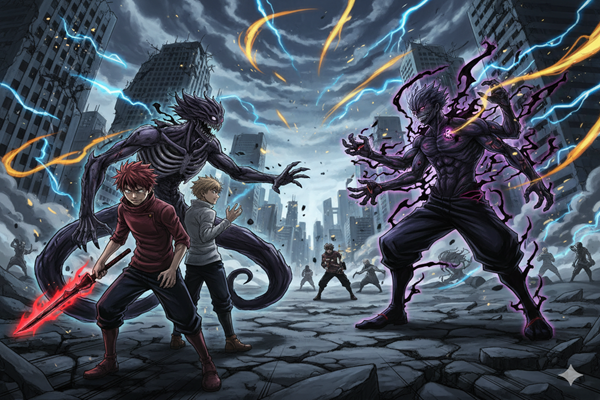
The final confrontation was Yuji and his allies against Sukuna in Megumi’s body.
This fight had been building since Chapter 1 — since the moment Yuji swallowed Sukuna’s finger and became his vessel. It was always going to come down to these two.
The Key Turning Point: Yuji’s Plan
The most clever moment of the final battle came when it was revealed that Yuji had been deceiving Sukuna all along.
Earlier in the fight, Yuta Okkotsu appeared to eat one of Sukuna’s fingers to absorb his power. But it turned out — that wasn’t Sukuna’s finger at all. It was a finger that Yuji had created from his own body. One of Sukuna’s actual fingers was still unaccounted for, and Nobara Kugisaki used this to execute her Resonance technique — attacking Sukuna’s soul directly by striking his own cursed object from a distance.
Combined with Yuji’s Black Flash strikes — which targeted the boundary between Sukuna’s cursed energy and Megumi’s trapped soul — the heroes were finally able to break Sukuna’s grip.
Megumi Is Freed — But at a Cost
One of the most emotionally heavy threads in the final arc was Megumi Fushiguro’s possession by Sukuna. For much of the endgame, Megumi was essentially absent, his soul suppressed inside his own body while Sukuna used him as a puppet.
Yuji’s Black Flash, aimed at the barrier between Sukuna and Megumi’s consciousness, was key to saving his friend. Megumi was eventually freed — though not without enormous psychological damage. He had been forced to watch Sukuna commit atrocities in his body, including the death of his sister Tsumiki (who had been used as a vessel by the curse Yorozu). Megumi had no real time to process that grief. By the end, he was alive — but profoundly broken.
Sukuna Is Defeated
In the end, Yuji defeats Sukuna.
The King of Curses — who had dominated the entire series and killed Gojo, Kashimo, Hazenoki, Choso, and many others — is brought down by Yuji Itadori, the boy he once dismissed as a temporary vessel.
What remained was a single Sukuna finger, no longer dangerous — just a remnant of what had been.
JJK Chapter 271: The Final Chapter Explained
Chapter 271 serves as both the conclusion of the battle and a glimpse into the world afterward. Here is what happens:
Back to Basics — Yuji, Megumi, and Nobara on a Mission
The chapter opens with the main trio reunited: Yuji, Megumi, and Nobara, responding to a call in Tokyo. The city is still saturated with residual cursed energy from the Culling Game, and that energy is causing problems for ordinary civilians.
A couple is being harassed by cursed energy at home. The trio investigates and tracks it down to a hidden sorcerer — someone who gained cursed abilities through the Culling Game and has been, accidentally or otherwise, causing harm.
When they confront him, the twist lands softly: he is not a villain. He is an ordinary, troubled person — a jealous lover who made bad decisions. He is not a Sukuna. He is not a Kenjaku. He is just someone who got caught up in something he did not understand and went down the wrong path.
Yuji, in a moment that crystallizes everything his character represents, doesn’t write him off. He tells the man to atone for what he’s done — and then come find them. Come join the new jujutsu society. There’s still a path forward.
This small scene carries enormous weight. It signals that the Jujutsu world has changed. The old system — secretive, brutal, kill-or-be-killed — is gone. What’s replacing it is something closer to rehabilitation, to giving people a second chance.
The Flashback with Gojo
Before the chapter closes, we get a flashback to a conversation between Yuji and Gojo that took place before the Shinjuku Showdown.
In it, Gojo tells Yuji something important: he doesn’t need to be the next Gojo Satoru. The world already has one of those — or rather, had one. What Yuji needs to do is forge his own path. There are enough sorcerers who fight like Gojo. Yuji’s approach — his belief in people, his refusal to write anyone off — is something different. Something the world needs more of.
It is Gojo passing the torch. Not just his strength, but his dream: a new generation of sorcerers, a reformed system, a world where curses don’t have to define everyone’s fate.
Sukuna in the Afterlife
One of the most surprising and quietly moving moments of Chapter 271 is what happens after Sukuna’s death.
We see Sukuna in a void — a liminal space between life and whatever comes next. He encounters Mahito, one of the series’ most nihilistic curses, still unchanged, still reveling in destruction and cruelty.
But Sukuna — the King of Curses, the most feared entity in the entire series — does something unexpected. He turns away from Mahito. He reflects on his life, on the choices that defined him, and for the first time, he opens himself to the idea of change.
Jujutsu Kaisen uses Buddhist symbolism around death throughout the series. Going South after death means remaining as you are — waiting in a kind of limbo or nirvana. Going North means reincarnating, re-entering the cycle of life to try again.
Gojo went South — content with who he was, leaving the living world to the next generation.
Sukuna chooses North. He accepts that he might change in his next life. Mahito is furious. But Sukuna walks away — and that is his ending.
For a character who spent the entire series as an embodiment of pure ego and destruction, this is a quiet, significant moment of growth. Yuji — the boy who believed in people even when it was irrational — may have started Sukuna’s redemption simply by refusing to give up on him.
The Final Page: Full Circle
The last panel of Jujutsu Kaisen is a close-up of Sukuna’s final finger, now housed in a wooden box at a small roadside shrine — the same type of setting glimpsed back in the very first chapter of the manga.
Here is the key detail: the finger is no longer a cursed object. Sukuna’s soul is gone. The finger carries no malicious energy anymore. Instead, it now functions as a talisman to ward off low-level curses — the exact opposite of what it was at the start of the story.
Something that began the series as a source of darkness and death has become, by the end, a small force for protection.
That is what Jujutsu Kaisen’s ending means, in its simplest form: the cycle of curses can be broken. Not completely, not forever — curses will always arise from human suffering. But the nature of those curses, and what humanity does with them, can change.
The JJK Epilogue Explained (Chapter 272 / Final Volume)
At Jump Festa 2025, Gege Akutami announced a 16-page bonus epilogue to be included in the final collected volume, which released in Japan on December 25, 2024. The English volume is expected in 2025.
The epilogue focuses on several characters and extends into the future in unexpected ways. Here is what it covers:
Nobara and Her Mother
Nobara Kugisaki, one of the most beloved characters in the series, gets a satisfying epilogue beat. One of the things Gojo left behind in his letters was information on the whereabouts of Nobara’s mother — a woman who, by all indications, was neglectful and absent.
True to form, Nobara’s response to the information is that she doesn’t care. But the fact that Gojo cared enough to track it down — and left it for her to do with as she wished — speaks to how well he knew his students.
Yuji and Yuko
In a lighter moment, the epilogue revisits Yuko Ozawa — the girl from Yuji’s old school who had a crush on him. Their interaction hints at the possibility of a romantic future for Yuji. After everything he has been through, it’s a warm, human moment.
Panda in the Year 2080
In the most jaw-dropping epilogue segment, the story jumps forward over 60 years into the future.
By 2035, Panda — the beloved cursed corpse who is essentially a sentient stuffed animal — has been placed in storage at a facility belonging to the Gojo family. Yuta Okkotsu, we learn, became the acting head of the Gojo clan.
Then the story jumps to 2080. Yuta has grandchildren now — a loud, rambunctious pair, the complete opposite of their quiet grandfather. They find Panda in storage and are treating him like a doll. Panda scolds them.
It is absurd and sweet and strangely moving. It confirms that the world Yuji and his friends fought for survived. It grew. It had the next generation, and the generation after that.
Sukuna and Uraume: The Touching Reveal
The epilogue saves its best moment for last.
A flashback shows Sukuna’s first meeting with Uraume — the devoted follower who served him across centuries. For most of the series, Sukuna was portrayed as entirely self-serving, caring for no one. But this scene reveals something important: Sukuna genuinely cared about Uraume. Among all the people in his long existence, this was one connection that was real.
It recontextualizes Sukuna slightly — not as a redemption, but as a reminder that even the most destructive people can have something human in them. It gives his earlier choice to go North more weight.
What Happened to the Major Characters?
Here is a character-by-character breakdown:
| Character | Fate |
|---|---|
| Yuji Itadori | Alive. Becomes a mentor figure, continuing Gojo’s dream of reforming jujutsu society. Possible romantic future with Yuko. |
| Megumi Fushiguro | Alive, but psychologically scarred. Freed from Sukuna’s possession. Working through deep trauma. |
| Nobara Kugisaki | Alive. Reunited with the team. Receives information about her mother from Gojo’s letters. |
| Satoru Gojo | Dead. Killed by Sukuna in the final arc. Goes South in the afterlife — at peace. |
| Sukuna | Defeated and dead. In the afterlife, chooses to go North, hinting at eventual reincarnation. |
| Yuta Okkotsu | Alive. Returns to his own body after the final battle. Eventually becomes head of the Gojo clan, lives long enough to have grandchildren by 2080. |
| Kenjaku | Dead. Killed by Yuta Okkotsu using a copied Reverse Cursed Technique. |
| Panda | Still “alive” (as a cursed corpse) in 2080, placed in the Gojo family’s storage. |
| Maki Zenin | Alive. Directs reincarnated sorcerers, helping rebuild the jujutsu world. |
| Hakari | Alive. Shown in the epilogue, continuing to operate. |
| Toge Inumaki | Alive. Makes an appearance in the final chapter’s group shot. |
| Uraume | Dies by suicide after Sukuna’s defeat. Featured in the moving epilogue flashback with Sukuna. |
| Choso | Dead. Died during the battle against Sukuna. |
| Kashimo | Dead. Fell during the final arc. |
Was the JJK Ending Good? An Honest Analysis
This is where I’ll give you my honest take — because the JJK ending has been genuinely divisive, and you deserve a real answer rather than a diplomatic non-answer.
What the Ending Got Right
Yuji’s arc lands. The final chapter’s small-scale mission — Yuji talking down an ordinary person who made bad choices — is the perfect encapsulation of who Yuji is and why he was the right protagonist. He didn’t need a massive final power-up or a world-saving moment. He just needed to be himself: someone who believes people can be more than their worst actions.
The thematic closure is strong. The idea that Sukuna’s finger becomes a protective talisman is elegant. The Buddhist North/South symbolism around death gives the afterlife scenes real weight. Gojo’s dream being passed on through Yuji’s actions feels earned.
The epilogue was a gift. The bonus chapter — especially the Panda-in-2080 segment and the Sukuna/Uraume flashback — showed that Akutami had more to say and said it with care.
Where the Ending Fell Short
The pacing throughout the final arc was brutal. This is the biggest and fairest criticism. The manga was clearly rushing to a conclusion, and a number of story threads — Megumi’s recovery, the full resolution of the sorcerer families, the fate of many supporting characters — were handled too quickly or left unaddressed.
Gojo’s ending remains painful for many fans. Killing the most popular character in the series before the final arc even fully began was a bold creative choice. His absence from the epilogue, the lack of a grave or a real farewell scene, left many readers feeling shortchanged. Gojo went South — he’s at peace. But the humans who loved him (and the readers who did too) didn’t really get to say goodbye.
The final chapter is short. At under 25 pages, Chapter 271 carries a lot of weight for a series finale of this scale. Some of what it does, it does beautifully. But there is an undeniable sense that more was needed — more pages, more closure, more time with these characters.
The Bottom Line
Jujutsu Kaisen’s ending is imperfect but meaningful. It is not the blow-out finale the series arguably deserved in terms of scope, but it is a thoughtful, thematically consistent conclusion. Yuji’s story ends in a way that honors who he always was. The world he leaves behind is better than the one he entered. And in a series built on the idea that curses and suffering are unavoidable — that is genuinely hopeful.
Will There Be a Jujutsu Kaisen Part 2 or Sequel?
As of early 2026, there is no announced sequel, Part 2, or continuation of Jujutsu Kaisen from Gege Akutami.
The final page with Sukuna’s finger sparked theories about a potential return, but within the logic of the story, the finger no longer contains Sukuna’s soul. The remaining characters are also significantly more powerful than they were at the start — any new threat would need to be absurdly scaled to feel credible.
The epilogue’s jump to 2080 suggests Akutami was thinking about legacy and the future of the world, not setting up a new conflict. If a sequel ever comes, it would likely follow entirely new characters in a changed jujutsu society.
For now, the story of Yuji Itadori is complete.
Where Can You Read the JJK Manga?
- Viz Media / Shonen Jump app — official English digital release
- Manga Plus — free official platform with the latest and first chapters
- The final collected volume (Volume 27) includes the epilogue chapter and is available through standard manga retailers
Frequently Asked Questions
Q: Is the JJK anime finished?
No. The anime adaptation is still ongoing. Season 3 (covering the Culling Game arc) is expected. The anime has not yet reached the ending covered in this article.
Q: How many chapters does JJK have?
The main series has 271 chapters, plus a 16-page epilogue (sometimes counted as Chapter 272) released with the final volume.
Q: Does Gojo come back at the end of JJK?
No. Gojo Satoru remains dead. He appears only in a flashback in Chapter 271 and is referenced in letters he left for his students. In the afterlife, he goes South — at peace, but not returning.
Q: Does Megumi survive JJK?
Yes. Megumi Fushiguro is freed from Sukuna’s possession and survives the series, though he is left with significant psychological trauma.
Q: What happened to Nobara in JJK?
Nobara Kugisaki survived and is part of the main trio in the final chapter. She receives information about her mother from a letter Gojo left her.
Q: What is the meaning of the final panel (Sukuna’s finger)?
Sukuna’s last finger, now emptied of his soul, is placed in a shrine where it acts as a protective talisman against low-level curses. It is the same type of setting shown in Chapter 1, and it symbolizes that something which once brought darkness can be transformed into something protective — the central theme of the series.
Final Thoughts
Six years. 271 chapters. One of the most intense, unpredictable, beautifully drawn manga to run in Weekly Shonen Jump.
Jujutsu Kaisen was never a comfortable story. It killed characters you loved. It asked hard questions about suffering and whether it can ever really end. It gave you a protagonist who had no special destiny, no magic power that was secretly his own — just a boy who decided that every life had value and acted on it, every single time.
The ending is not perfect. But it is honest. And in the world of Jujutsu Kaisen — a world where curses rise from everything broken and ugly in human experience — honesty matters more than a clean resolution.
Yuji Itadori changed that world. Not by being the strongest. By being the most human.
That’s what Jujutsu Kaisen was always about.