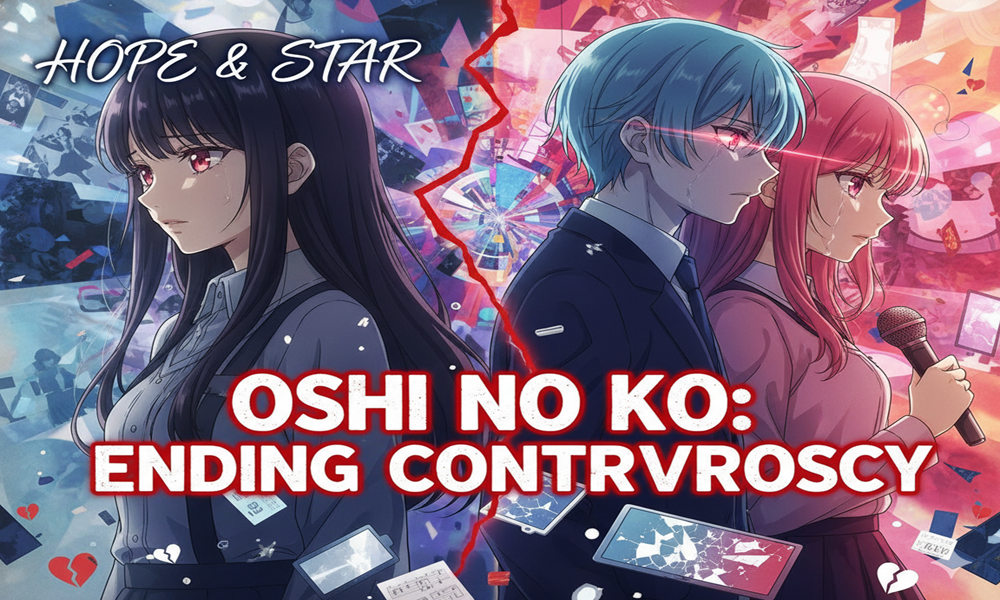
Quick Answer: Yes, the Oshi no Ko manga is finished. It concluded on November 14, 2024, with Chapter 166. The ending — in which protagonist Aqua Hoshino dies in a double-suicide to defeat villain Hikaru Kamiki — sparked one of the most heated manga debates of 2024.
1. Is the Oshi no Ko Manga Finished?
Yes — the Oshi no Ko manga officially ended on November 14, 2024, with its 166th chapter. After over four years of serialization in Shueisha’s Weekly Young Jump (beginning April 23, 2020), the story of Aqua and Ruby Hoshino came to a close across 16 tankōbon volumes.
By the time it concluded, the series had achieved remarkable commercial success: over 25 million copies in circulation as of December 2025, making it one of the best-selling manga of the past decade. The anime adaptation, produced by Doga Kobo, ran two seasons (April 2023 and July–October 2024) before a third season premiered in January 2026.
Despite this success, the ending itself became one of the most divisive manga conclusions of recent memory.
2. What Actually Happens at the End of Oshi no Ko?
⚠️ Major Spoilers Below
To understand the controversy, you first need to understand what actually happens.
The final arc, titled “Toward the Stars and Dreams” (beginning around Chapter 153), centers on Aqua finally confronting his biological father, Hikaru Kamiki — the manipulative, dangerous man responsible for murdering his mother, idol Ai Hoshino.
Here is a chapter-by-chapter breakdown of the key events:
The Confrontation: Aqua manages to screen The 15 Year Lie, a biopic he produced to expose the truth behind Ai Hoshino’s life and death. At the screening, Hikaru Kamiki admits his involvement in Ai’s murder. Aqua also shares a DVD containing Ai’s private confession — that she truly loved Hikaru — which fills Hikaru with immense guilt.
The Threat Escalates: A former B-Komachi member named Nino, consumed by grief over Ai, plots to murder Ruby. This introduces a secondary threat running parallel to the Hikaru storyline.
Aqua’s Fatal Decision: Realizing that Hikaru cannot be neutralized through legal or social means alone, Aqua decides on an extreme measure: he stabs himself and pulls Hikaru into the sea with him, orchestrating what amounts to a double-suicide. His plan is to kill them both and ensure that the blame for everything falls on Hikaru, thereby protecting Ruby’s career and public image.
His plan succeeds. Aqua’s body is found preserved by the cold ocean water. Both Kana Arima and Ruby are devastated.
The Epilogue (Chapter 166): The final chapter jumps forward in time. Ruby, once unable to leave her house after her brother’s death, has rebuilt herself. She now has white stars in both eyes — symbolically merging Aqua’s spirit with her own and mirroring Ai’s pure joy. Ruby has become a superstar idol, arguably surpassing her mother Ai. She continues to perform and smile for her fans… even while concealing her grief. Life goes on. The world applauds.
3. Why Is the Oshi no Ko Ending So Controversial?
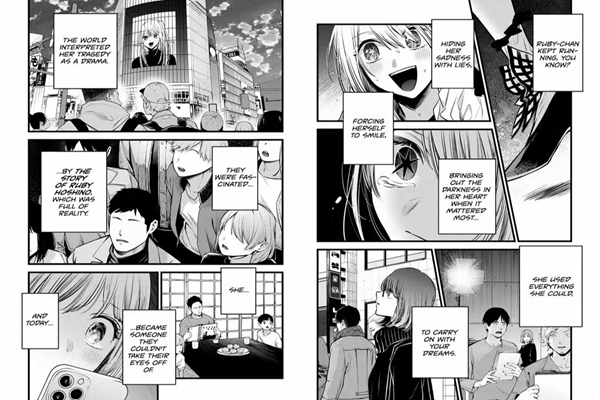
The backlash did not come out of nowhere. Fans had four years invested in this story, and several specific narrative choices in the final arc clashed hard with what readers expected — or felt the series had promised.
Here are the core reasons for the controversy, explained plainly:
A) Aqua’s Death Felt Contradictory to His Character Arc
For most of the manga, Aqua’s story reads as a healing journey. Yes, he is driven by revenge — but as the series progresses, readers watch him form genuine connections with Kana, Akane, Ruby, and others. He slowly becomes more than just a vessel for vengeance.
Many fans felt the ending invalidated this growth. Instead of choosing life — choosing the people who love him — Aqua essentially reverts to his original one-track mission: destroy Hikaru at any cost, even his own life. Critics argue this made his entire emotional development feel meaningless.
B) Ruby Ends Up in the Same Trap as Ai
This is arguably the deepest thematic complaint. Oshi no Ko spent years building a critique of the entertainment industry — particularly the way it forces idols to perform happiness while suffering privately. Ai Hoshino’s tragedy was precisely this: she smiled for the cameras while secretly in pain.
The ending places Ruby in the exact same position. She performs for her fans. She smiles. She conceals her grief. And the manga frames this as… growth? As a good thing?
To many readers, this felt like the series abandoning its own thesis — or worse, endorsing the very cycle it had spent years condemning.
C) The Ending Felt Rushed
The final arc covered enormous narrative ground in a small number of chapters. Hikaru Kamiki — the series’ ultimate antagonist — received relatively limited buildup and screen time compared to his plot significance. Multiple characters and subplots were left without resolution. Kana Arima, one of the most beloved characters in the series, was essentially sidelined in the final stretch.
Some fans believed this pointed to editorial pressure to conclude the series quickly, though this has never been officially confirmed.
D) The Double-Suicide Framing
A vocal subset of readers criticized the manga for what they perceived as glorifying suicide as a noble or romantic act. However, it’s worth noting that the narrative never presents Aqua’s choice as admirable — virtually no character in the story approves of what he did. Even Aqua himself, in his final moments, begins to regret his decision.
4. The Case FOR the Oshi no Ko Ending
Not everyone hated it. A significant portion of the fanbase — and some critics — have defended the ending, and their arguments deserve fair consideration.
Aqua’s death was heavily foreshadowed from the very beginning. He raised death flags constantly from the moment Ai died in Chapter 1. His singular obsession with revenge was never fully resolved through internal healing alone — the external conflict with Hikaru remained. When a character is emotionally healing while an unresolved external threat looms, many storytelling traditions signal that resolution will be fatal.
The ending is thematically coherent, even if it’s painful. Oshi no Ko is a dark story about the entertainment industry’s cost on human beings. A bittersweet, tragic ending is arguably more honest to the story’s DNA than a tidy, happy resolution would have been.
Ruby’s arc does represent a form of growth. She has gone from a fragile girl chasing her mother’s ghost to a confident artist forging her own path. The white stars in both eyes symbolize that she carries Aqua with her — she has integrated her grief rather than been destroyed by it. Whether this is “healthy” is debatable, but it is not nothing.
Aqua achieved his goal. The truth about Ai’s life was revealed. Hikaru was brought down. Ai’s legacy was restored. Aqua protected Ruby. By his own standards, he succeeded.
5. The Case AGAINST the Oshi no Ko Ending
To be balanced, here is a consolidated version of the strongest criticisms:
- Theme betrayal: The series critiqued performers who sacrifice authenticity for applause. The ending rewards Ruby for doing exactly that.
- Wasted character development: Aqua’s emotional growth across hundreds of chapters feels voided by his final choice.
- Unresolved subplots: Characters like Kana deserved more conclusive arcs.
- Villain undercooked: Hikaru Kamiki spent too little time on-page for his defeat to feel satisfying.
- Rushed pacing: Too much story was crammed into too few chapters in the final arc.
- The romance question: Aqua and Akane’s relationship, which was one of the most compelling dynamics in the series, was largely set aside in the finale.
6. What Did the Creator Say About the Ending?
This is where it gets interesting. Unlike many mangaka who stay silent after a divisive conclusion, Aka Akasaka addressed the controversy directly.
In an interview published on Shueisha’s official website, Akasaka confirmed that the series ended exactly as he had envisioned. He did not blame editors, scheduling, or outside pressure. This was his intended ending.
Meanwhile, artist Mengo Yokoyari took to X (formerly Twitter) to address the fan reaction. She noted the difficulty of having a nuanced discussion about an ending she had poured her heart into. Her message made clear that the creative team felt the conclusion had a genuine, hopeful message — even if that message was painful.
Akasaka also remarked warmly on Yokoyari’s contributions, acknowledging her as a skilled storyteller in her own right (pointing to her hit manga Scum’s Wish as evidence of her independent talent).
One month before the ending published, Akasaka himself warned fans that the final arc would be controversial — suggesting he knew exactly how it would be received and chose to proceed anyway. That’s a notable act of artistic conviction, whatever you think of the result.
7. How Does the Oshi no Ko Ending Compare to Other Manga Endings?
2024 was a rough year for high-profile manga conclusions. The discourse around Oshi no Ko did not exist in isolation.
| Manga | Ending Year | Fan Reception |
|---|---|---|
| My Hero Academia | 2026 | Mixed — criticized for rushed resolution |
| Jujutsu Kaisen | 2026 | Largely negative — many felt key characters were shortchanged |
| Oshi no Ko | 2026 | Divisive — strong feelings on both sides |
| Kaguya-sama: Love is War | 2025 | Controversial final arc, but generally accepted |
This pattern has led to a broader conversation in manga fandom about whether the weekly serialization format — which prioritizes speed and volume over deliberate, measured storytelling — is structurally incompatible with satisfying endings.
It has also fueled criticism of Aka Akasaka specifically, with some fans noting that both his major works (Kaguya-sama and Oshi no Ko) had controversial final arcs. His upcoming fantasy manga, announced with illustrations by Ajichika of Record of Ragnarok fame, has already attracted skeptical comments from readers who feel burned.
8. What Happens Next: Season 3, Live-Action Film, and More
Despite the ending controversy, the Oshi no Ko franchise has continued expanding.
Anime Season 3 premiered in January 2026, adapting the later manga arcs and bringing the story to animated audiences. The third season covers Ruby’s continued rise in the entertainment industry, building toward the events of the manga’s controversial final arc.
Live-Action Film: Oshi no Ko: The Final Act premiered in Japanese theaters on December 20, 2024, and was later added to Amazon Prime Video in the United States in June 2025.
Mobile Game: Oshi no Ko: Match Star was released globally in February 2026 for iOS and Android.
The franchise shows no signs of slowing down commercially, even if the manga’s conclusion left a sour taste for some readers.
9. Final Verdict: Is the Oshi no Ko Ending Really That Bad?
Here is my honest take, having looked at this from multiple angles:
The Oshi no Ko ending is not a disaster — but it is a deeply flawed conclusion that failed to honor everything the series built.
The thematic contradiction at the core of the ending (the series critiques idol performance culture, then ends with Ruby performing and concealing her pain as a positive arc) is a real, legitimate problem. It is not a matter of “fans wanting a happy ending.” It is a matter of a story contradicting its own central argument.
At the same time, Aqua’s death was earned. It was foreshadowed. It was consistent with who he was — a man who never fully let go of his mother’s death, no matter how much he healed in other ways. The tragedy is real and it lands.
What the ending actually needed was more time. More pages. More resolution for Kana, Akane, and others. The final arc was compressed in a way that made the conclusion feel incomplete rather than conclusive.
Is it one of the worst manga endings ever? No. Is it worthy of the series it closes? Probably not. That’s the honest answer.
10. Frequently Asked Questions
Is the Oshi no Ko manga finished?
Yes. It concluded on November 14, 2024, with Chapter 166, spanning 16 volumes.
Does Aqua die at the end of Oshi no Ko?
Yes. Aqua dies in a double-suicide with antagonist Hikaru Kamiki, drowning in the sea to protect Ruby’s future.
Does Ruby become a successful idol?
Yes. The epilogue shows Ruby as a major star who has surpassed even her mother Ai Hoshino in terms of fame and influence.
Why did Aka Akasaka end the series this way?
In his official post-series interview, Akasaka stated the ending was exactly as he intended. He pre-warned fans the final arc would be controversial.
Is Oshi no Ko Season 3 out?
Yes. Season 3 premiered in January 2026.
How many copies has Oshi no Ko sold?
Over 25 million copies in circulation as of December 2025.
Will there be more Oshi no Ko content?
The anime Season 3 is ongoing. A mobile game launched in February 2026. A live-action film was released in December 2024.